Home Decor & Styling
The Homemaker's Guide to Everyday Kitchen Organization
Kitchen organization content usually comes from people styling a kitchen for a photo, not running one every single day. This is for the latter: practical, not aspirational, and built around real repeated use rather than a one-time setup that never actually gets tested by daily life.
Snacks need their own system
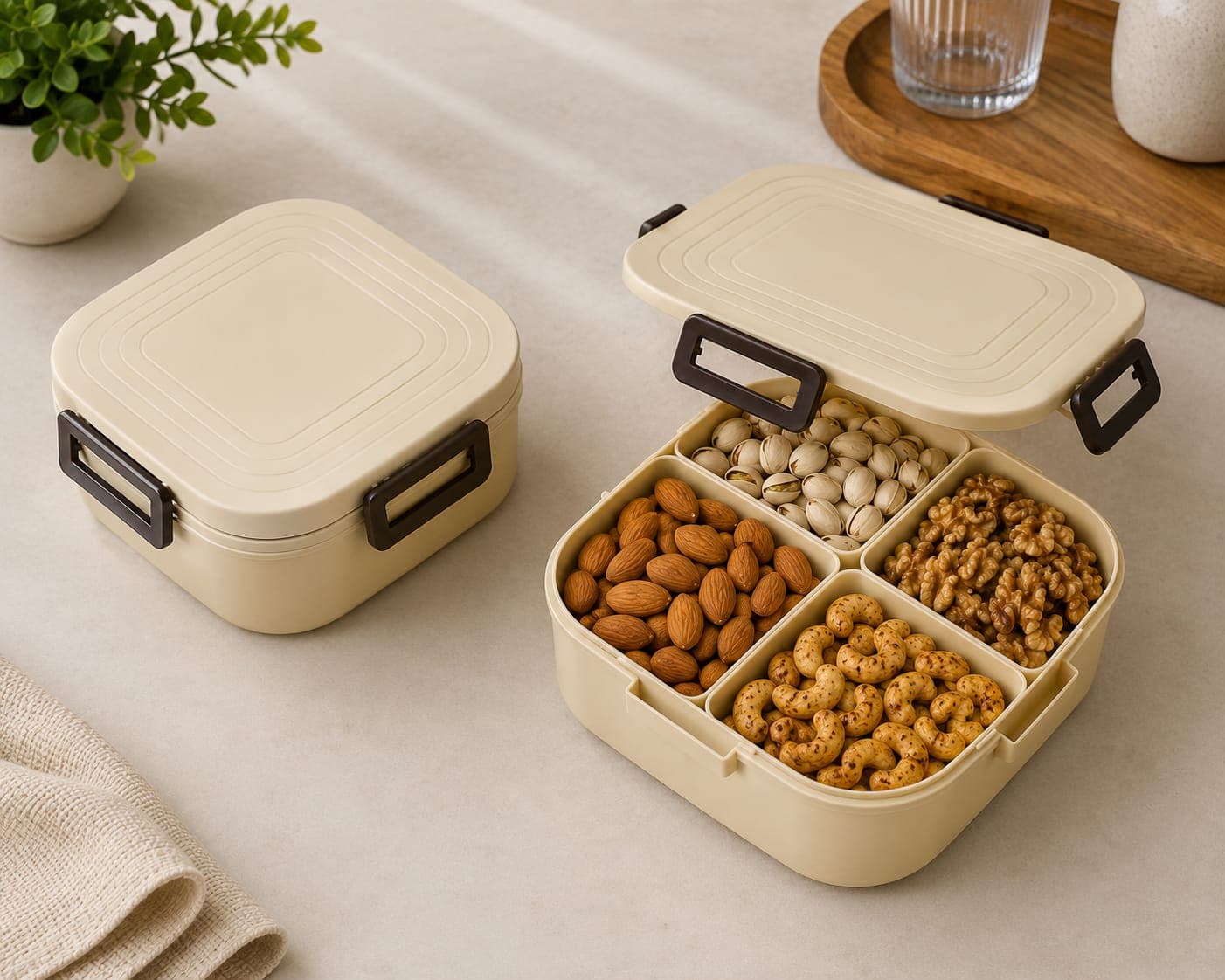
Kids or adults rummaging through cabinets looking for something to eat is a daily kitchen stressor that compounds over a week of interrupted cooking and constant re-tidying after every search. A 4-Compartment Snack & Nut Box solves it in one move. Everything visible, everything already portioned and ready to grab.
Keep condiments where you cook
Steel Salt & Pepper Shakers belong at the stove, not in a cabinet three steps away: small friction adds up over hundreds of meals cooked in the same kitchen, year after year, without anyone questioning why the layout is the way it is.
Dish soap deserves better than a bottle under the sink
A 3-in-1 Soap Dispenser & Sponge Holder keeps the sink area tidy and looks intentional instead of purely utilitarian, without adding a single extra step to washing up after a meal is finished.
Pack lunches without the leak anxiety
The Salad To-Go Jar with Dressing Cup removes the "will this spill in the bag" worry that comes with regular containers, which matters more than it sounds on a rushed morning when there's no time to double-check the lid before running out the door.
Build in a weekly reset, not a daily one
Rather than trying to keep everything perfect every single day, pick one fixed time each week to reset the kitchen fully: wipe surfaces, restock the snack box, check what needs replacing before it runs out mid-week. It's more sustainable than chasing constant tidiness that never quite sticks.
Match storage to how the kitchen gets used
An Airtight Storage Container Set works best placed exactly where the ingredient gets used, not where it's traditionally "supposed" to live: cooking rhythm should dictate layout more than convention or how a magazine kitchen happens to be arranged.
Involve everyone who uses the kitchen
A system only one person understands falls apart the moment they're not around to maintain it: keep labeling simple and placement logical enough that anyone in the household can put things back correctly without having to ask.
Leave room to adjust as habits change
A layout that worked perfectly a year ago might not fit new cooking habits or a new member of the household: revisit the setup occasionally rather than assuming it's fixed forever once it's been arranged.
Design around your actual cooking sequence
Arrange items in the order you reach for them while cooking (the Steel Salt & Pepper Shakers at the stove, prep tools near the counter) rather than grouping purely by category on a shelf somewhere convenient to store.
Give guests a self-serve option
A Marble-Finish Canister Set with Tray near the entrance to the kitchen lets guests help themselves to tea or coffee without needing a full tour of where everything lives in your cabinets.
Keep one drawer or shelf flexible
Not everything needs a fixed home. One adaptable space for whatever's currently in rotation, a new gadget or a seasonal item, keeps the rest of the system from having to bend every time something new enters the kitchen.
Plan for the messiest hour of the day, not the cleanest
Most kitchens look their best right after a deep clean and their worst during active dinner prep: design your systems around that chaotic hour, since that's when good organization earns its keep.
Keep a short list of what needs replacing
A running note of what's low or worn (a shaker that's sticking, a container missing its lid) means restocking happens in one efficient trip instead of several frustrated ones discovered mid-cooking.
Build systems that survive a guest cooking too
A layout only you understand breaks down the moment someone else tries to help in the kitchen: clear, intuitive placement means a guest or family member can pitch in without constant direction from you.
Don't chase a magazine-perfect kitchen
The goal here is a kitchen that functions well under real daily pressure, not one that photographs perfectly: a well-organized kitchen sometimes looks a little lived-in, and that's a feature, not a flaw.
The real principle
Organization that survives daily use has to be easier than the disorganized alternative, not only prettier on a shelf: every system here passes that test because it removes a step rather than adding one to an already busy routine.
Ready to gift?